Tigrinya recordings to text, in Ge'ez script with English
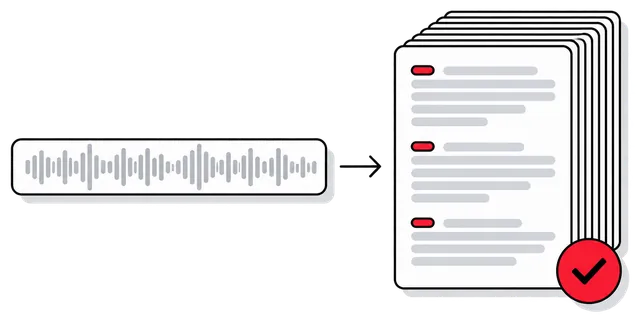
Upload a Tigrinya audio or video file and get it written in Ge'ez (Fidel) script, paragraph by paragraph with timestamps, and an English translation under every paragraph. If the recording is 15 minutes or shorter, it is free in full. Longer recordings show their first part free; the whole file, up to 6 hours, is $5.
- Tigrinya has its own entry in the language list; choose it, not Amharic
- Written in Ge'ez (Fidel) script as Unicode text, left to right
- Eritrean and Tigrayan speech written as spoken
- English translation preselected under each paragraph
- Up to 6 hours for one payment of $5
Real output from a demo recording. Click a timestamp to see where it sits in the audio.
Same script as Amharic, different language
Tigrinya and Amharic share the Ge'ez script, so a page of either looks alike to an outsider. The languages themselves differ in grammar and much of their vocabulary. Set the spoken language to Tigrinya, as this page does. With Amharic selected, a Tigrinya speaker can come back with Amharic-looking spellings or wrong words.
Eritrean Tigrinya and the Tigrinya of the Tigray region in Ethiopia differ in accent and in some words; Eritrean speech also carries some Italian loanwords from the colonial period. Both are written as spoken. Tigre, Saho and Bilen are separate languages and are not in the list.
Church recordings and Ge'ez passages
Many long Tigrinya recordings are sermons, Bible teaching and services from Orthodox Tewahedo, Catholic and evangelical churches. Preaching in Tigrinya is the main target. Liturgical passages sung in classical Ge'ez are a different language, not in the list, so those stretches may be written loosely or marked [inaudible]. Hymns with music under them are harder than speech.
If you want a sermon outline as well as the transcript, the Sermon Transcription tool writes one from the same kind of transcript.
For lawyers, caseworkers and families
Tigrinya speakers live in Eritrea and Ethiopia and in large communities in Sudan, Germany, Sweden, the Netherlands, the UK, Israel and North America. Their recordings often have to be read by someone who does not know the language: an asylum interview checked by a lawyer, a voice message from a relative read by an English-speaking child. The English line under each Tigrinya paragraph lets that reader follow, and the Tigrinya stays above it for anyone who wants to check.
The result is a draft made by an AI speech model. It is not a certified transcript or a sworn translation.
Before you pay, check this
- Read the free first part with the audio playing and see whether names and key sentences are right
- Listen again wherever you see [inaudible]
- Check dates: speakers may use the Ethiopian calendar, and a date said that way is written as said, not converted
- Rename "Speaker 1" and "Speaker 2" on screen; numbers can change between parts of a long file
How the tool works, what it costs and how your files are handled is on the Long Audio & Video to Text page; prices for every tool are on the pricing page.
Last updated
Questions and answers
Why does a chat assistant stop partway through my Tigrinya sermon?
A long sermon holds more words than fit in one chat reply, and audio uploads are capped in length. The assistant shortens or stops. This tool splits the file into parts, writes each one out, and joins them in order.
Is Tigrinya less accurate than English?
You should expect more mistakes, because far less Tigrinya audio exists for training. The free first part is there so you can judge your own recording before paying.
What does a two-hour recording cost?
$5, one time, for anything up to 6 hours. With Unlimited at $19 a week you get up to 12 hours per job; cancel whenever you want.
Can I get a translation into Arabic or German instead?
Yes. Change "Also translate" before uploading, or turn it off to get only the Tigrinya.