Transcribe long Kiswahili recordings to text
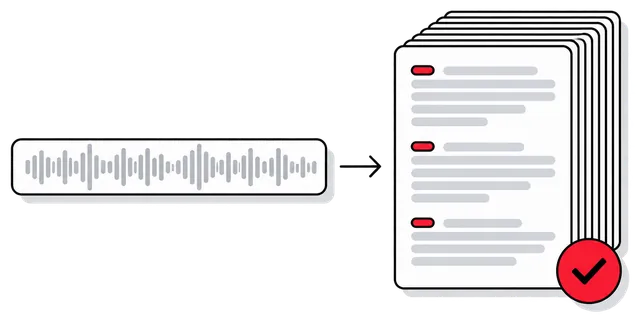
Upload a Swahili audio or video file and get the whole transcript with a timestamp at every paragraph, written as it was spoken, English words and Sheng included. Translation is optional: pick English or another language if you need one. A recording up to 15 minutes long is free in full. Longer recordings open with a free part; the full file, up to 6 hours, is $5.
- Kiswahili written in its standard Latin spelling
- Kenyan, Tanzanian and Ugandan speech written as spoken
- Sheng and English inside Swahili kept as they were said
- Optional translation under each paragraph, off by default
- Up to 6 hours and 2 GB for $5
Real output from a demo recording. Click a timestamp to see where it sits in the audio.
Research interviews and focus groups
A lot of long Swahili audio comes from fieldwork: health, agriculture and development projects in Kenya, Tanzania and Uganda, where interviews and focus groups are held in Kiswahili and the report is written in English. Upload each recording and you get a word-for-word transcript with timestamps. If you also choose English under "Also translate", the English appears under every Swahili paragraph, so a supervisor can follow and a Swahili-speaking colleague can check.
Speaker changes are marked "Speaker 1:", "Speaker 2:" when they are clear. In a long focus group the numbering can change from one ten-minute part to the next, so check it and rename speakers with Find and replace before you code the data.
Sheng, English and regional speech
Standard Swahili is based on the speech of Zanzibar, and Tanzanian speakers often stay close to it. In Nairobi, young speakers use Sheng, a mix of Swahili, English and other Kenyan languages, and office Swahili everywhere is full of English. The tool writes what was said and does not correct Sheng into standard Swahili. Slang that changes fast may be spelled in more than one way; that is normal for Sheng even when people write it themselves.
Speakers in eastern Congo, Rwanda and Burundi also use Swahili, with their own accent and words. Kikuyu, Luo, Luganda and Sukuma are not in the language list; passages in them may be marked [inaudible].
Other long recordings
- Sermons and Bible teaching in church, khutbah and darsa at the mosque
- Community, county and cooperative meetings
- Radio programs and talk shows saved as a file
- Lectures and trainings
Honest limits
The transcript is made by an AI speech model. Clear speech near the microphone comes out well; outdoor recordings, generators, music and people talking over each other cause mistakes. Names of people, villages and organizations are written as heard. Treat the transcript as a draft to check, not a certified record.
How the tool works, what it costs and how your files are handled is on the Long Audio & Video to Text page; prices for every tool are on the pricing page.
Last updated
Questions and answers
Can a chatbot handle a two-hour Swahili focus group?
It tends to hit audio limits or return a shortened version, and it cannot give reliable timestamps for a long file. This tool transcribes every part in full and keeps the time of each paragraph.
What does a long interview cost?
$5 for the whole recording, up to 6 hours. For a week of fieldwork, Unlimited at $19 a week covers recordings of up to 12 hours each; cancel any time.
Can I get English under the Swahili?
Yes. Choose English under "Also translate" before uploading, or add it after the transcript is done.
Is my data used to train AI?
No. The recording is visible only to you and is sent to an AI model provider only to be transcribed. Jobs without an account are deleted after 7 days, and you can delete a job any time.